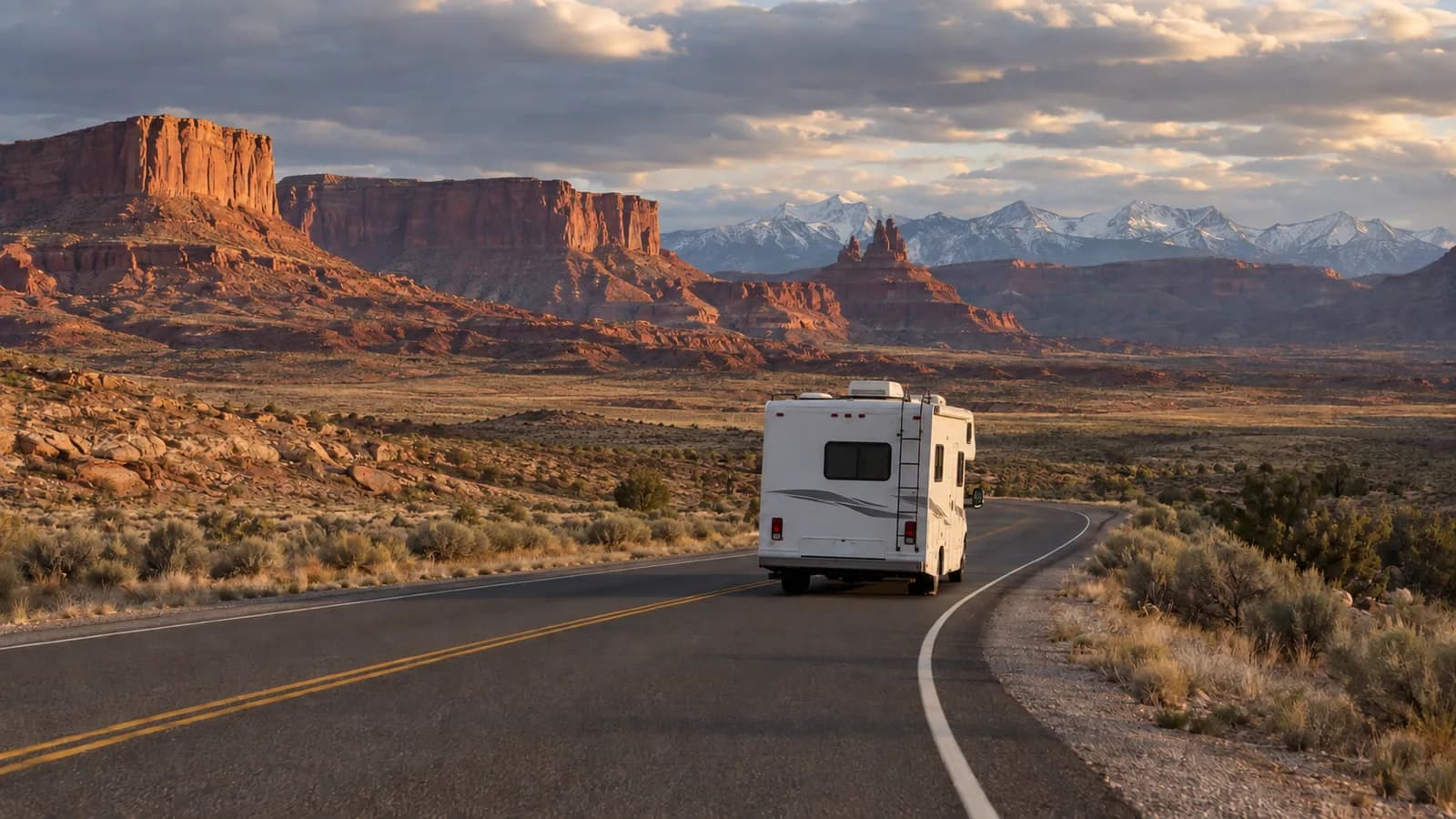
A Class C motorhome on a two-lane Utah highway with red rock mesas ahead and the Wasatch range behind

Antelope Island State Park RV rental from Salt Lake City

Reviewed by Ben Kiser, RV rental operator and fleet consultant.

The rule that governs this destination

Utah State Parks publishes no RV length limit for the causeway or for any campground here, so nothing stops a rig by size. Power and water decide instead, and both exist in one loop: Bridger Bay sites 27 to 64, three of which are cottages where RVs are not permitted. Book one of the 35 hookup sites that leaves, or cross the causeway with full tanks. There is no gas station on the island, the only other tap is the dump station in that same loop, and rideshare drivers will not come out to collect you.

Antelope Island at a glance

Read from the park’s own pages on . Limits change, so check the source before you book.

Distance from Salt Lake City
41 miles

The park adds 7 miles west of the entrance gate across the Davis County Causeway, so the gate is not the island. Utah State Parks publishes no drive time.

Drive time
Not published

No source publishes one.

Tightest published length that bars a vehicle
Not published

No road here is closed by length alone.

Listings measured near Salt Lake City
610

610 publish a length, 86 a height, 80 a width.

What is closed to you, in the park's own words

Quoted rather than paraphrased, because a paraphrase of a size limit is how a foot goes missing between the source and the page you read it on.

Difficult, not banned

The Davis County Causeway, the only road onto the island

The only road on, and the old South Causeway is not an alternative

Note: Access to the Island is via the Davis County Causeway (Antelope Island Road) only. No access via the old South Causeway.
https://stateparks.utah.gov/parks/antelope-island/directions/
Campgrounds, and what each one will take

Where a column reads not published, no page published by the agency that runs this ground states a figure. That is the source being silent, not this page being incomplete.

Published RV limits, site counts, hookups, seasons and dump stations at every Antelope Island campground
CampgroundMax RV lengthSitesHookupsSeasonReservationsDump station
Bridger Bay CampgroundNot published64Water and electricity in the upper loop, sites 27 to 64, only. No sewer at any site. Flush restrooms and showers in both loops.Camping is provided year-round in designated campsites. Dispersed camping is not permitted.Reserve America, four-month rolling window statewide, and at least two days in advance. Day prior and day of are first come, first served.Yes
White Rock Bay CampgroundNot publishedNot publishedNone. Water is at Bridger Bay Beach, the dump station and the visitor center.No season is published for this campground on its own. The park states camping is year-round.Same rule as Bridger Bay. At least two days in advance, otherwise first come, first served.No
Lakeside Group Campsite, in White Rock BayNot published1NoneNo season published for this site on its own.Group sites statewide open on an 11-month rolling window, against four months for individual sites.No
Ladyfinger CampgroundNot published5None. Pit toilets only, no fires permitted.No season published for this campground on its own.At least two days in advance.No
  • Bridger Bay Campground. No published length limit. Utah State Parks publishes the loop split instead, and the loop split is the figure that matters. Sites 27 to 64 are the hookup loop, 38 sites, and sites 27, 28 and 30 of those are cottages where RVs are not permitted. Derived on 2026-09-19 from the park's own numbering: 61 of the 64 sites take a vehicle and 35 of them have water and electricity. Two loops, six ADA accessible sites. Fee covers one vehicle and a second is $18 a night, which is $126 across a week for anyone who tows a car.
  • White Rock Bay Campground. No published length limit, and the park's two official pages do not agree on how many sites there are. Self-contained rigs only: no water, no electricity, pit toilets, with flush toilets and showers two miles away at Bridger Bay Beach. The $40 fee covers two vehicles rather than one, which is the opposite of Bridger Bay. The camping opportunities page says 8 sites. The park fees page says 20. Both are live on stateparks.utah.gov and neither is dated. Recorded as a conflict rather than picked.
  • Lakeside Group Campsite, in White Rock Bay. No published length limit. One site for up to 80 people and 20 vehicles, self-contained RVs welcome, with no water and no electricity. At $180 a night covering 20 vehicles it is the cheapest per-vehicle camping on the island, and the only site here that a reunion of more than 16 people can legally use.
  • Ladyfinger Campground. Not an RV campground at all, and it is on this table so nobody books it by mistake. Tent camping only, one tent per site, hike-in about 230 feet from the parking area, four people and one vehicle per site.

Numbers that do not agree, and who to ask

Both positions are printed. Neither is averaged into a figure no source supports, and neither is quietly dropped.

How many sites White Rock Bay has

  1. "White Rock Bay Campground – 8 sites"

    Utah State Parks, Antelope Island camping opportunities page

    https://stateparks.utah.gov/parks/antelope-island/camping-opportunities/
  2. "White Rock Bay Campground (20 sites)"

    Utah State Parks, Antelope Island park fees page

    https://stateparks.utah.gov/parks/antelope-island/park-fees/

The only campground on the island that takes a large group in a self-contained rig, and its size is stated two ways by the same agency. A party planning around 20 sites may find eight. Neither page carries a date, so there is no way to tell which is the newer.

Confirm at: Antelope Island visitor center, 801-725-9263

What the biting insect is called and when it is out

  1. "Biting gnats (no-see-ums) emerge in the spring (April – June)." Midges form columns "throughout the summer" and brine flies "emerge during mid-summer".

    Utah State Parks, Antelope Island frequently asked questions

    https://stateparks.utah.gov/parks/antelope-island/frequently-asked-questions/
  2. "Biting midges (no-see-ums) (Currently NOT active) emerge in the spring (April – June)." Midges form columns "mid-spring through early fall" and brine flies move onto land "early-summer through fall".

    Utah State Parks, Antelope Island current conditions, last updated 09/15/2026

    https://stateparks.utah.gov/parks/antelope-island/current-conditions/

The park does publish a seasonal insect advisory, which almost no RV guide mentions, and it publishes it twice with different names and different seasons. The one that bites is called a gnat on one page and a midge on the other, and the park says repellent does not work on it. A head net is the only remedy either page offers, and you buy that before you leave Salt Lake City, not on an island with no shop.

Confirm at: Antelope Island visitor center, 801-725-9263

What the Davis County Causeway fee actually is

  1. "Annual State Park Passes do not cover the $2 Davis County Causeway fee."

    Utah State Parks, Antelope Island park fees page

    https://stateparks.utah.gov/parks/antelope-island/park-fees/
  2. "A separate Causeway Sticker can be purchased at the park entrance booth for $15." The same page also heads the section "Entrance fees (includes causeway fees)" and prices entrance at $15 per vehicle.

    The next sentence on that same page

    https://stateparks.utah.gov/parks/antelope-island/park-fees/

One page names the causeway fee as $2 and prices the sticker that covers it at $15, in consecutive sentences. It decides whether a Utah annual pass holder pays $2 or $15 at the booth, and the $65 Antelope Island annual pass is the only product the page says covers the causeway outright.

Confirm at: Antelope Island entrance booth or visitor center, 801-725-9263

Questions no official page answers

These are the questions a renter asks that no official page answers. Each one was checked rather than assumed, and a gap is recorded as a gap. Filling one with a plausible number would be the most useful-looking lie on the page.

  • Any RV, trailer or vehicle length limit. Checked the camping opportunities page, the park fees page, the facilities page, the directions page, the map page and the FAQ on 2026-09-19. Not one states a maximum length, a maximum width or a turning restriction, for the causeway or for any campground. The Davis County Causeway is a county road, so it does not appear in UDOT's secondary-highway restriction table either, because that table is indexed by state route number. Ask the visitor center on 801-725-9263 about a specific site before booking a long rig.
  • Whether a camping fee includes the $15 entrance. The cottage line is the only one on the page that says so, word for word: "Fee covers entrance to the park, and two vehicles." Every other campground line names the vehicles covered and says nothing at all about entrance. The silence reads as no, and a silence that reads as no is still a silence. Two nights at Bridger Bay is $60 or $75 depending on the answer.
  • What counts as a second vehicle. Bridger Bay charges $18 for an additional vehicle and caps a site at two. No Utah State Parks page says whether a motorhome towing a car, or a pickup with a travel trailer, is one vehicle or two. On a week that is the difference between $210 and $336 at the no-hookup rate.
  • Whether the dump station and its potable water run through the winter. Camping is year-round, the facilities page lists "A Dump Station with potable water", and no page gives it a season. It is also the only water in the upper loop, so if it is shut the hookup loop is the only place left with a tap.
  • Any drive time. Utah State Parks publishes 41 miles from Salt Lake City and 7 miles of causeway and no time for either. No agency page states how long the causeway takes at RV speed.

Sources

Salt Lake City RV Rental is a finder. It owns no RVs and is not affiliated with the National Park Service, the Utah Office of Tourism or UDOT. Park rules change between seasons, so read the source before you book.

Everywhere else this market drives to

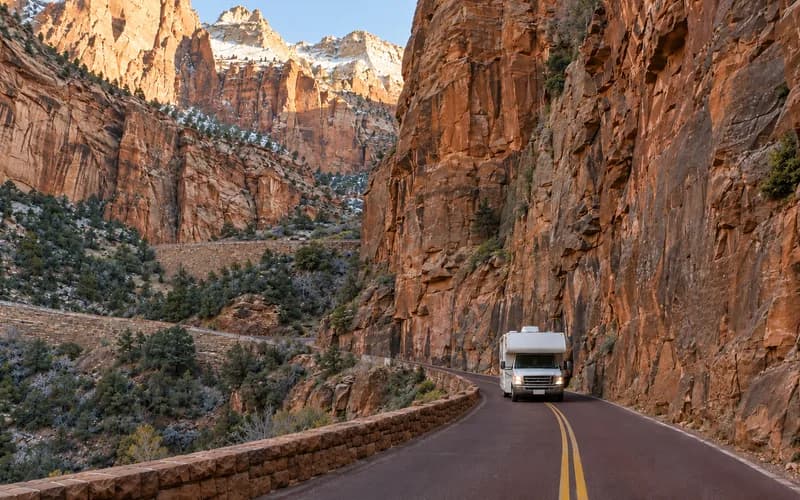
A motorhome on a narrow canyon road below sheer sandstone walls, showing how little clearance the route allows

Zion National Park

300 miles, per National Park Service

What stops a vehicle here

Since 7 June 2026 there is no tunnel permit. An RV over 35 ft 9 in long, 7 ft 10 in wide or 11 ft 4 in high is turned around at Canyon Junction, and the width measurement includes your mirrors.

4 hours 15 minutes, per the Utah Office of Tourism

Read the limits
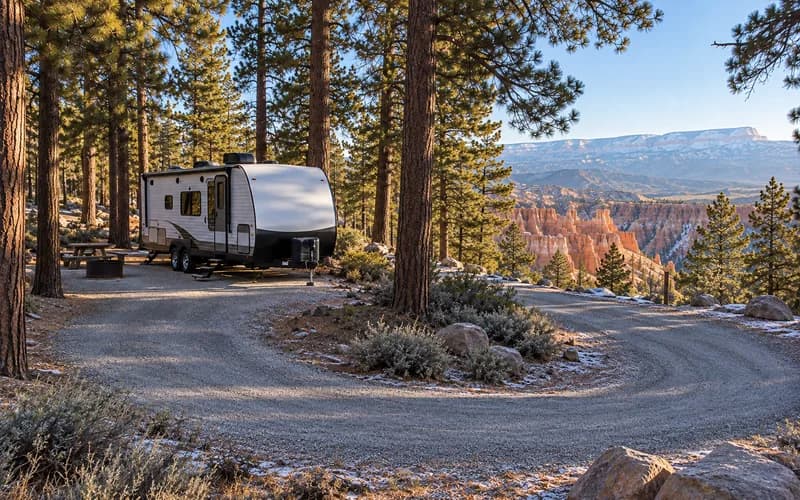
A travel trailer parked in a pine-shaded campground loop on the rim above Bryce hoodoos

Bryce Canyon National Park

270 miles, per National Park Service

What stops a vehicle here

Bryce Point Road and Paria View Road are closed to RVs over 20 ft and to anything towing. That closure appears only in the Superintendent's Compendium, not on a single page a visitor would normally read.

4 hours, per the Utah Office of Tourism

Read the limits
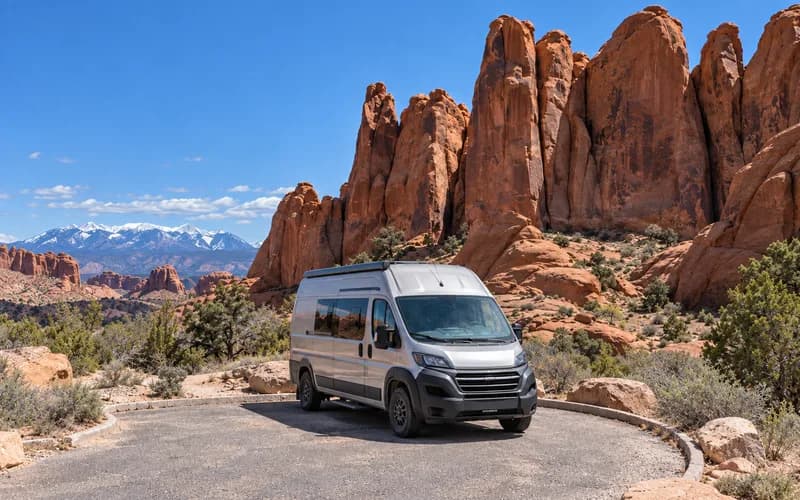
A camper van in a slickrock parking area with sandstone fins rising behind it

Arches National Park

236 miles, per National Park Service

What stops a vehicle here

Timed entry is not required at Arches in 2026, which most RV guides still get wrong. The constraint that replaced it is physical: NPS tells oversize vehicles to leave the rig in town or in the visitor center lot, and the park has no dump station, so you empty tanks in Moab.

3.5 to 4 hours to Moab, per the Utah Office of Tourism

Read the limits
A short camper van at the start of an unpaved gravel road running out across a mesa top

Canyonlands National Park

237 miles, per National Park Service

What stops a vehicle here

The Elephant Hill Access Road bans anything over 21 ft. It is an ordinary-looking two-wheel-drive gravel road to a major trailhead, and a 28 ft rig legal in both park campgrounds is illegal on it.

3.5 to 4 hours to Moab, per the Utah Office of Tourism

Read the limits
A motorhome on a paved scenic drive beside historic orchards below striped cliffs

Capitol Reef National Park

Not stated by the National Park Service

What stops a vehicle here

Capitol Reef publishes two different RV limits for Grand Wash and Capitol Gorge, 27 ft and 23 ft, and a 25 ft Class C sits between them. Book under 23 ft if you want both spur roads, because the 23 ft figure is on the more recently updated page. Take a 25 ft rig and you may reach the turning and have to reverse it out.

3.5 hours, per the Utah Office of Tourism

Read the limits
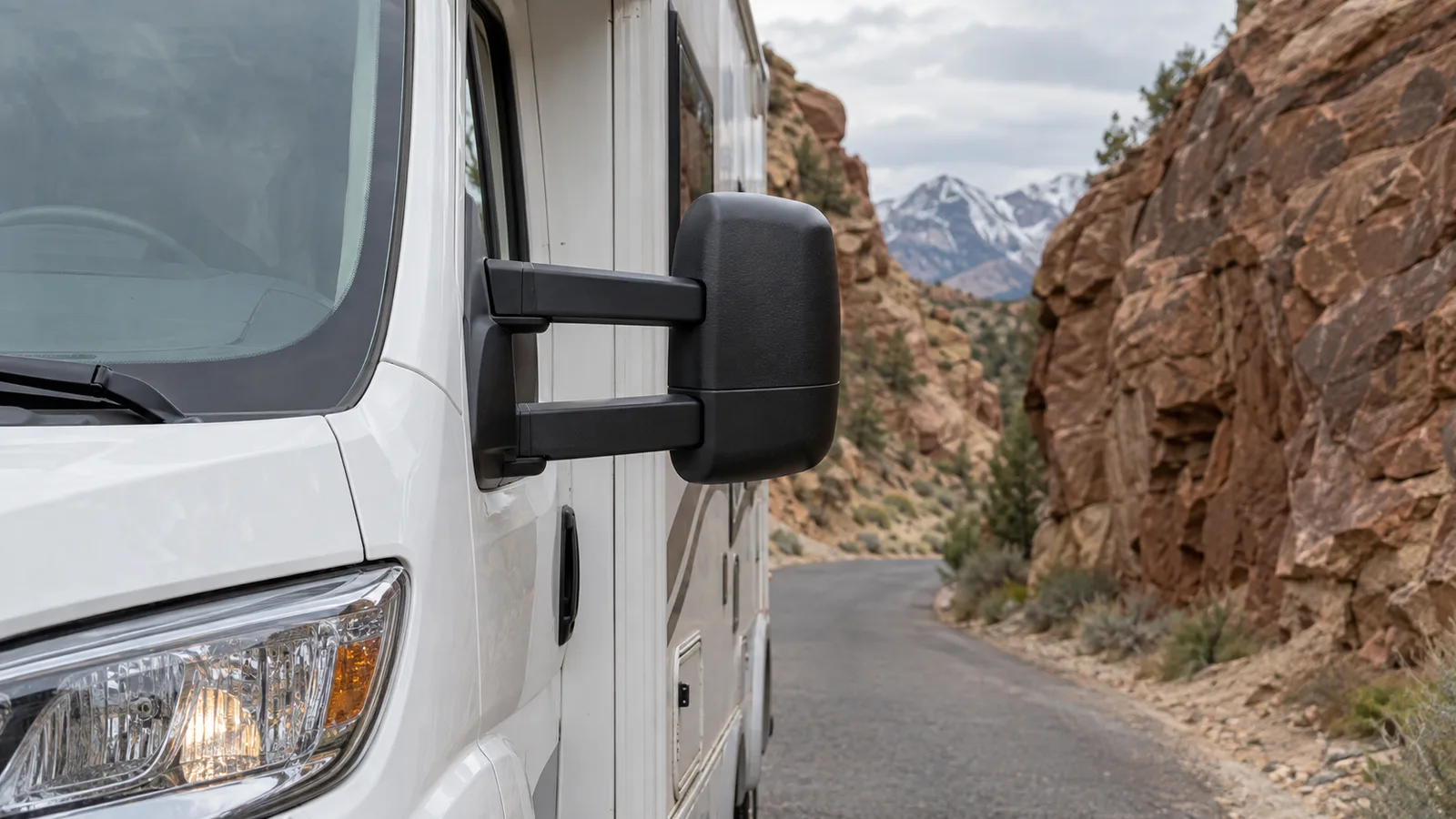
A close view of a motorhome's extended side mirror against a narrow rock passage

Mirror Lake Highway

Not stated as a total by the Forest Service or UDOT

What stops a vehicle here

The only limit UDOT publishes for SR-150 is 80,000 lbs, and the heaviest RV in this market is rated 51,000. No length, width or height limit exists for the road. What decides is the season: Mirror Lake Campground opens 22 June and closes 20 September, 91 days, and UDOT publishes no date for the closure at either end of it.

Read the limits
A close view of a motorhome's extended side mirror against a narrow rock passage

Flaming Gorge National Recreation Area

205 miles, per US Forest Service

What stops a vehicle here

No road in publishes an RV length limit and the campsites here are the longest in this data set, up to 80 ft at Mustang Ridge. What decides is water. There are no hookups anywhere in the recreation area, drinking water at most campgrounds runs only from mid to late May to mid September, and the pass you need to be here cannot be bought online.

Read the limits
A close view of a motorhome's extended side mirror against a narrow rock passage

Bear Lake State Park

Not stated by Utah State Parks

What stops a vehicle here

Bear Lake publishes no RV length limit. It publishes pad lengths instead, 64 ft to 105 ft at Birch and 44 ft to 68 ft at Big Creek, all of them full hookup. What decides is whether you can book at all, because the park's conditions page says every Rendezvous Beach, South Eden and North Eden site is first come, first served until closing in October while its own facilities page still sends you to Reserve America.

Read the limits